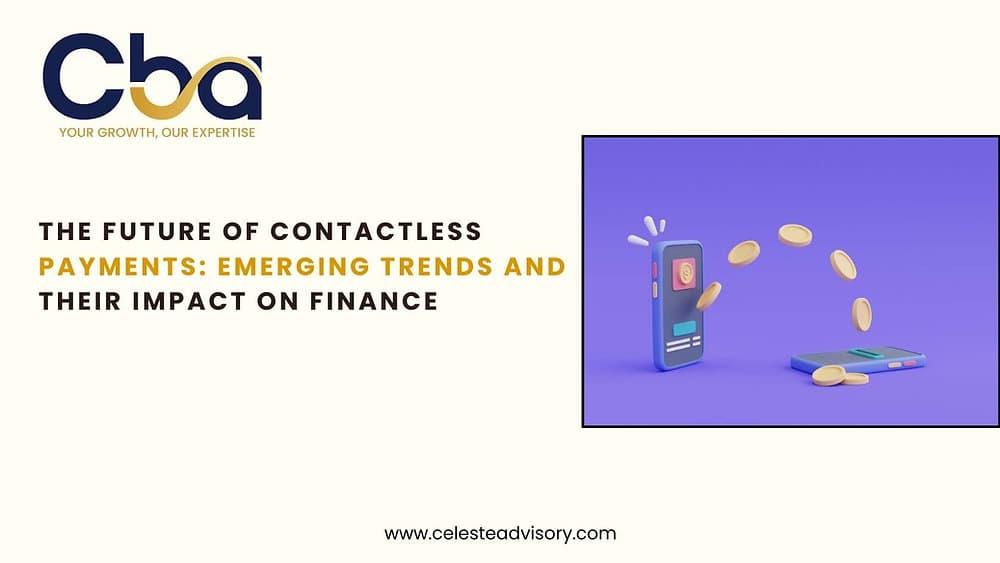
Here is the short answer. The future of contactless payments is that they stop being a feature and become the default. Tap-to-pay is already the normal way to pay at a US checkout, and the next few years extend the pattern: phones acting as both wallet and terminal, biometric approval replacing PINs, QR codes carrying whole payment ecosystems in other markets, and real-time settlement rails such as FedNow moving money in seconds instead of days. For a business, the impact lands in five places: faster checkout, faster access to cash, richer transaction data, lower cash-handling cost, and a fraud surface that shifts online.
A contactless payment is a transaction completed by holding an NFC-enabled card or device near a terminal, or by scanning a QR code, with no swipe, insertion, or signature. Celeste Business Advisors works with US small and mid-sized businesses on the finance side of this shift: what acceptance costs, what faster settlement does for cash flow, and where the risks moved. This article covers the technology, the trends worth watching, and what to actually do about them.
Where Contactless Payments Stand in 2026
Contactless adoption followed a familiar curve: slow for a decade, then vertical. The pandemic pushed consumers and merchants toward touch-free checkout at the same moment banks finished reissuing cards with NFC chips, and the habit stuck; industry trackers put global contactless transaction volume above $10 trillion as far back as 2023, and growth has continued since. The United States, long a laggard behind Europe, Asia, and Australia, has largely caught up: tap-to-pay now dominates card-present transactions at major US retailers, and mobile wallets such as Apple Pay and Google Wallet keep taking share from physical cards, especially among younger customers.
The practical consequence for a business owner is that acceptance is no longer optional differentiation. Customers assume the tap will work, and a checkout that forces a chip insertion or, worse, cash only, now reads as friction.
How the Technology Works
Contactless cards and wallets use near-field communication (NFC), a short-range radio standard that lets a card or phone exchange data with a terminal a few centimeters away. The security layer that makes this safe is tokenization. Tokenization is the substitution of the real card number with a one-time or device-specific token, so the number that travels through the terminal and the merchant's systems is useless to a thief who intercepts it. Mobile wallets add a second layer by requiring the phone's biometric unlock, fingerprint or face, before the token is released.
This architecture is why contactless payments are more secure than the magstripe swipes they replaced, not less: there is no static card number to skim, and a stolen phone cannot pay without its owner's face or finger.
Five Trends Shaping the Next Few Years
| Trend | What it is | Why it matters to a business |
|---|---|---|
| Biometric authentication | Fingerprint or face approval built into wallets like Apple Pay and Samsung Pay | Stronger security with less checkout friction; fewer abandoned transactions |
| Tap-to-phone (softPOS) | A standard smartphone acts as the card terminal, no extra hardware | Acceptance cost falls toward zero for mobile and low-volume sellers |
| Wearable payments | Watches, rings, and fitness bands with NFC, such as Garmin Pay and Fitbit Pay | Customers expect every checkout to take every form factor |
| QR code payments | Camera-scanned payments dominant across Asia via Alipay, WeChat Pay, and India's UPI | Cheap acceptance model; growing US use in restaurants and invoicing |
| Real-time rails | Instant settlement networks: FedNow and RTP in the US, UPI in India | Money arrives in seconds, transforming cash flow timing |
Two of these deserve a closer look. Tap-to-phone quietly removes the last hardware barrier to card acceptance: services like Tap to Pay on iPhone let a contractor, market vendor, or delivery driver accept cards with nothing but the phone already in their pocket. And real-time rails change the finance question from "how do we get paid" to "when." The Federal Reserve's FedNow service and the RTP network settle transfers in seconds around the clock; India's UPI shows where this leads at national scale, a story we cover in our piece on how UPI reshaped payments globally.
What This Means for Your Business Finances
The payment method mix is a finance decision, not just an operations one, and it shows up in four places.
Cash flow timing. Card settlements typically arrive in one to two business days; real-time rails compress that to seconds. For a business managing tight working capital, shaving even a day off average collection changes the weekly cash position materially.
Processing cost. Contactless convenience is not free; card and wallet transactions carry processing fees that land directly on your margin. The discipline is to read your processing statement annually, compare providers, and build the fee into pricing rather than absorbing it silently.
Reconciliation and data. Digital payments arrive with structured data that modern accounting stacks, QuickBooks or Xero connected to Stripe or Square, can match automatically. Businesses that wire this up close their books faster and get customer-level sales insight that a cash drawer never produced. The same shift is remaking online retail economics, which we examine in our article on e-commerce financial trends.
Fraud exposure. As card-present fraud gets harder, fraud migrates online to card-not-known channels and to payment-instruction scams. The controls that matter are covered in our guide to cybersecurity in financial transactions.
The Challenges to Watch
Four frictions will shape how fast the future arrives. Security concerns persist, less about the tap itself, which tokenization protects well, and more about account takeover and online fraud around the edges of the system. Acceptance costs remain a genuine burden for thin-margin businesses, and fee structures are getting more complex, not less. Interoperability is unfinished; wallets, rails, and QR schemes still do not all talk to each other, which is why your checkout needs to accept several of them. And a meaningful share of customers still prefers or depends on cash, which argues for adding payment options rather than removing them.
How to Prepare Your Business
The playbook is short. Make sure your terminals accept NFC wallets as well as physical cards, and if you sell away from a counter, look at tap-to-phone before buying hardware. Offer at least two digital payment paths so one provider's outage does not stop your revenue. Review your processing statement once a year and renegotiate or switch when volume justifies it. Connect payments to your accounting software so reconciliation is automatic. And treat settlement speed as a working-capital lever: if slow payouts are financing your processor rather than your business, faster rails are worth their cost.
Deciding which of these is worth doing first is a cash flow and margin question, the kind our fractional CFO service answers with your actual numbers rather than industry averages.
Frequently Asked Questions
Are contactless payments safe?
Yes, generally safer than the payment methods they replaced. Contactless transactions are protected by tokenization, which substitutes the real card number with a useless-if-stolen token, and mobile wallets add biometric approval on top. The realistic risks sit around the edges of the system, in phishing and account takeover, not in the tap itself.
What does it cost a small business to accept contactless payments?
Acceptance costs have two parts: hardware and per-transaction processing fees. Hardware cost is falling fast, and tap-to-phone services can eliminate it entirely by turning a standard smartphone into the terminal. Processing fees are the larger long-term cost, so compare providers on the effective rate across your real transaction mix, not the headline rate.
What is tokenization in payments?
Tokenization is the replacement of a real card number with a one-time or device-specific token during a transaction, so the sensitive number never passes through the merchant's systems. If the token is intercepted or the merchant is breached, the token cannot be reused elsewhere. It is the core security technology behind contactless cards and mobile wallets.
What is FedNow and does my business need it?
FedNow is the Federal Reserve's instant-payment service, launched in 2023, which settles transfers between participating US banks in seconds, around the clock. Access comes through your bank rather than directly. It is worth asking your bank about if slow settlement or wire fees are a real cost in your business, for example for time-sensitive vendor payments or payouts.
Will contactless payments replace cash completely?
Not in the foreseeable future. Digital payments keep taking share, but a meaningful portion of customers still prefers or depends on cash, and some jurisdictions require merchants to accept it. The practical strategy for a business is additive: support tap, wallets, and QR where customers want them while keeping cash workable where it matters.
The Bottom Line
Contactless payments have moved from novelty to default, and the interesting questions for a business owner are now financial: what acceptance costs, how fast the money lands, what the data enables, and where the fraud risk went. Treat your payment stack as part of your finance function and revisit it yearly; the rails are changing quickly enough that last year's setup is rarely this year's best answer.
If you want help turning payment choices into better margins and steadier cash flow, talk to Celeste Business Advisors and we will look at the numbers with you.