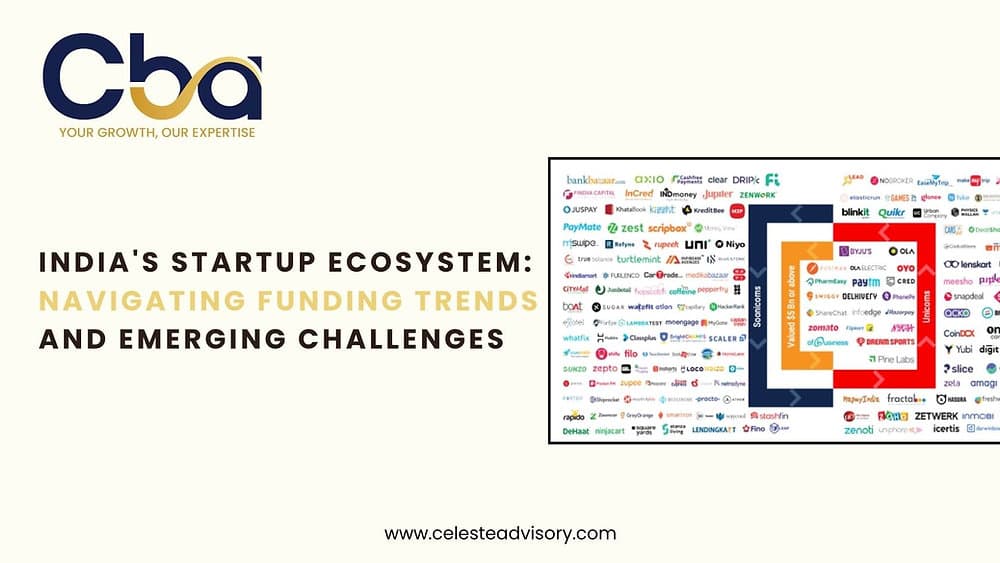
Here is the short answer: India's startup ecosystem remains one of the largest in the world, but the era of easy money is over, and the companies winning in 2026 are the ones that treat capital as scarce even when it is offered. Funding has shifted from growth at any price toward proven unit economics, regulators have removed long-standing irritants such as the angel tax, and a domestic listing has become a genuine alternative to a foreign acquisition as the exit path. For anyone building or backing an Indian startup, the game is now discipline, compliance, and demonstrated profitability.
This article covers where funding stands, what the recent reforms actually changed, the challenges that remain, and what operating teams should do about all of it. Celeste Business Advisors works with growing businesses on exactly these questions, so the recommendations below come from engagements, not commentary.
Where Startup Funding in India Stands
The reset is visible in the deal data. In the first half of 2024, Indian startups raised approximately $5.3 billion across 504 funding deals, about 2% below the same period a year earlier. The headline decline was modest, but the composition change underneath it was not: fewer mega-rounds, longer diligence cycles, tighter term sheets, and a clear investor preference for companies with a credible path to profitability over companies with only a growth story.
That discipline has persisted into 2026, and most operators now treat it as the permanent state of the market rather than a phase. Capital is available, often abundantly, for businesses with sound economics and clean governance; it is scarce for everyone else. The practical consequence is that fundraising has become a reporting exercise as much as a storytelling exercise, and companies with a reliable monthly close, cohort-level margin data, and audited statements move through diligence at a different speed than companies reconstructing their numbers for the data room.
The Reforms That Changed the Rules
The angel tax was a levy charged on capital that Indian companies raised above the fair market value of their shares, and for years it created valuation disputes between early-stage companies and tax authorities. In July 2024 the government abolished it, removing a source of friction that had discouraged domestic angel investment and complicated routine fundraising for young companies.
A second change arrived in September 2024, when the Ministry of Corporate Affairs amended cross-border merger regulations to streamline the process for foreign-domiciled Indian startups relocating their holding structures back to India. This so-called reverse flip matters because many Indian startups incorporated abroad in earlier fundraising eras, and India's strong domestic IPO appetite now rewards being structured at home.
| Shift | What changed | What it means for startups |
|---|---|---|
| Angel tax abolished (July 2024) | Levy on capital raised above fair market value removed | Cleaner early-stage rounds; less valuation dispute risk with tax authorities |
| Cross-border merger rules eased (September 2024) | Simpler route for foreign-domiciled startups to move back to India | Domestic listing path opens without a punishing restructuring process |
| Investor discipline | Diligence is longer; unit economics get priced, not promised | Plan longer runways and raise on evidence, not narrative |
| Exit expectations | Domestic public markets now a realistic exit | Governance, audit readiness, and reporting discipline start earlier |
The Challenges That Remain
Funding constraints top the list. With venture capital more selective, startups need alternative financing routes, from venture debt to revenue-based structures, and above all business models that generate their own cash sooner. Choosing between borrowed money and sold equity is a structural decision with long consequences; our comparison of business loans versus equity financing lays out the tradeoffs.
Regulatory compliance is the second persistent load. GST administration, transfer pricing for cross-border structures, data protection obligations, and sector-specific rules in fintech and health all demand attention that early teams rarely budget for. The reforms have removed irritants, but the overall compliance bar has risen with scale, and investors increasingly test for it during diligence rather than after.
Competition and governance round out the picture. Well-funded rivals exist in nearly every attractive segment, so differentiation and capital efficiency have to carry more weight than spending power. And after several years of high-profile governance failures in the ecosystem, boards and investors have far less patience for weak financial controls, related-party surprises, or reporting that cannot be reconciled.
What Startup Teams Should Do in 2026
Know your unit economics cold. Contribution margin per order, per customer, or per cohort is the number that now opens or closes funding conversations, and it has to come from a monthly close you trust rather than a spreadsheet built the week before the pitch.
Plan runway conservatively. A common practitioner guideline is to raise for 18 to 24 months of operations and to start the next raise while at least six months of cash remain, because diligence timelines have lengthened and bridge financing is expensive when sought under pressure. Preparation compounds here: companies that maintain investor-grade reporting continuously raise faster and on better terms, a dynamic covered in our guide on how startup advisory helps secure funding.
Take governance seriously before it is demanded. Clean cap tables, timely audits, an independent perspective on the board, and financial controls proportionate to scale all cost less to build early than to retrofit during diligence or IPO preparation. If the company was incorporated abroad, the eased merger rules make 2026 a sensible year to evaluate whether the structure still serves the business.
The Wider Economic Backdrop
Startups are one engine inside a much larger story. India's push toward a significantly larger economy rests on manufacturing, digital public infrastructure, and services exports alongside venture-backed innovation, and policy attention keeps shifting among them; our overview of India's path to a $5 trillion economy maps the strategy. Foreign capital flows shape the same picture from the other side, since global investors allocate to India across public markets, private equity, and venture together. For that lens, see our review of foreign direct investment trends in India. The relevant point for operators is simple: the macro tailwind is real, but it rewards companies positioned to absorb institutional capital, which is a finance and governance capability, not a marketing one.
Frequently Asked Questions
What was the angel tax and why did its removal matter?
The angel tax was an Indian tax levied on capital that companies raised above the fair market value of their shares, which frequently turned routine startup fundraising into a valuation dispute with tax authorities. Its abolition in July 2024 removed that friction, making early-stage investment cleaner for both domestic and foreign backers. For young companies it means one less structural risk attached to every round.
What is a reverse flip?
A reverse flip is the relocation of a startup's holding company from a foreign jurisdiction back to India. Amended cross-border merger regulations from September 2024 streamlined the process, and the main motivation is access to India's domestic public markets for an eventual listing. It is a significant legal and tax project, so it is best evaluated well before any IPO timeline forces the decision.
Why did startup funding in India slow down?
Global venture capital repriced risk after the low-rate era ended, and Indian deal activity followed: roughly $5.3 billion across 504 deals in the first half of 2024, slightly below the prior year. The deeper change was qualitative, with investors demanding proven unit economics and stronger governance rather than growth alone. That standard has outlasted the downturn itself.
How much runway should a startup plan for?
A widely used practitioner guideline is 18 to 24 months of runway at each raise, with the next fundraise beginning while at least six months of cash remain. Longer diligence cycles make thin buffers dangerous, and capital sought under pressure is always the most expensive kind. The right number for any specific company depends on its burn profile and revenue reliability.
How does a fractional CFO help a startup raise funding?
A fractional CFO builds the financial infrastructure investors test for: a reliable monthly close, unit economics by cohort, a defensible forecast, and a data room that reconciles. They also manage the process itself, from term sheet comparison to diligence responses, at a fraction of the cost of a full-time hire. For companies between rounds, the same discipline shortens the path to profitability.
The Bottom Line
India's startup ecosystem is maturing rather than shrinking. The funding data shows selectivity, the reforms show a government clearing structural obstacles, and the exit environment increasingly rewards companies built to institutional standards from the start. The winners in 2026 will be the teams that treat financial discipline and governance as products of the company, not paperwork for investors.
If your company needs that discipline built, from unit economics to investor-ready reporting, our FP&A service does exactly this work. Talk to us about where your numbers stand before the next raise tests them.