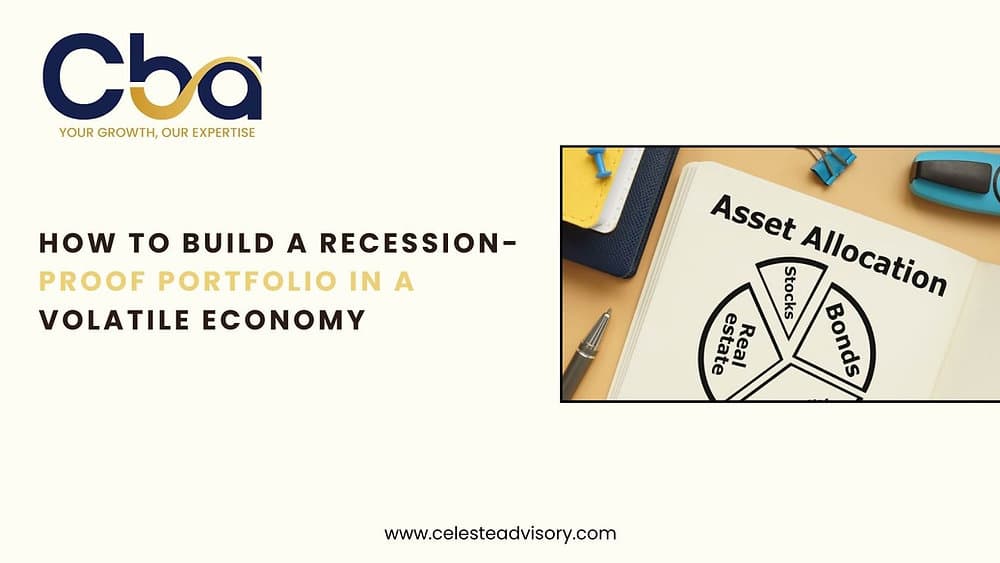
Here is the short answer. You cannot make a portfolio recession-proof, but you can make it recession-resistant with five disciplines: diversify across asset classes so no single bet can sink you, tilt part of the equity sleeve toward defensive sectors like consumer staples, healthcare, and utilities, hold a real cash reserve so you are never a forced seller, invest on a fixed schedule instead of trying to time the bottom, and rebalance on a calendar so the portfolio's risk does not drift with the market's mood. None of these steps predicts a recession. All of them assume one will arrive eventually and remove its power to force bad decisions.
Celeste Business Advisors is a fractional CFO and advisory firm, and most of our clients are business owners whose largest asset is the company itself. That changes the portfolio math in ways generic investing advice misses, so this guide covers both the standard playbook and the owner-specific layer.
What "Recession-Proof" Actually Means
A recession-resistant portfolio is one built so that a downturn damages it less than the broad market and never forces a sale at the bottom. That second clause is the one that matters. Most permanent losses in downturns come not from prices falling, prices recover, but from investors who had to sell while they were down: to cover living costs, a margin call, or a business cash crunch. Structure, not prediction, is what prevents that. Downturns are a normal part of the economic cycle; the portfolio's job is to survive them with its owner's judgment intact.
Diversify Across Asset Classes
Diversification is the practice of spreading investments across assets that do not fall together, so the portfolio's outcome never depends on one holding. The core building blocks:
- Stocks. A mix of large-cap, mid-cap, and small-cap holdings, with large caps in essential industries historically holding up better in contractions. Broad index funds remain the simplest way to own the mix cheaply.
- Bonds. Government and high-quality corporate bonds provide income and ballast when equities fall. Funds like the iShares 20+ Year Treasury Bond ETF (TLT) offer long-duration Treasury exposure, though long bonds swing hard when rates move, as the last few years demonstrated. Shorter-duration Treasuries and high-grade bond funds are the steadier ballast.
- Commodities. Gold has a long record as a store of value in stress periods; the SPDR Gold Shares ETF (GLD) is the common vehicle. Treat it as a small stabilizer, not a growth engine.
- Real estate. Real estate investment trusts (REITs) add income and an asset class that does not move in lockstep with stocks, though they are sensitive to rates and to recessions in their own tenants.
The rate environment matters to every one of these sleeves, which is why we keep a standing explainer on how interest rates hit your finances. In 2026, with rates down from their peak but well above the last decade's floor, bonds genuinely pay again, which restores the classic diversification math that a zero-rate world had broken.
Tilt Toward Defensive Sectors
A defensive sector is one whose demand barely falls in a recession because people buy its products regardless of the economy. The classic three are consumer staples (food, household goods), healthcare, and utilities. Companies in these sectors tend to hold earnings, and often dividends, through contractions, which cushions the equity sleeve. The trade-off is symmetrical: defensives usually lag in strong bull markets. The point of the tilt is not to maximize any single year but to narrow the range of outcomes so you stay invested through the cycle.
Hold Cash Like You Mean It
A cash reserve does two jobs in a downturn. It covers emergencies without forcing you to liquidate investments at depressed prices, and it funds opportunity, because bear markets are when good assets go on sale. For households, the standard guidance is three to six months of expenses; business owners should hold more, because recessions tend to hit business income and portfolio values at the same time. High-yield savings accounts, money market funds, and short Treasury bills all do the job while earning real interest at 2026 rates. Building the reserve without gutting your lifestyle is its own discipline; our guide to building an emergency fund covers the mechanics.
Discipline Beats Timing
Dollar-cost averaging is the practice of investing a fixed amount on a fixed schedule regardless of market conditions. It removes the timing decision entirely: you automatically buy more shares when prices are low and fewer when they are high, and you never sit in cash waiting for a clarity that does not come. Its mirror image, market timing, fails for a structural reason: the market's best days cluster tightly around its worst days, so an investor who steps out to avoid the drop usually misses the rebound that repairs it. Rebalancing completes the discipline. Rebalancing means periodically selling what has grown past its target weight and buying what has shrunk, typically once or twice a year, which quietly enforces buying low and selling high. These three habits, plus the patience to ignore headlines, prevent most of the mistakes we catalog in common investment pitfalls.
The Recession-Resistant Toolkit at a Glance
| Component | Job in a downturn | Typical vehicles | Watch out for |
|---|---|---|---|
| Broad equities | Long-term growth engine | Index funds across market caps | Concentration in one stock or sector |
| Defensive equities | Cushion earnings and dividends | Staples, healthcare, utilities funds | Lagging returns in strong bull years |
| Bonds | Income and ballast | Treasuries, high-grade corporates, TLT for long duration | Long duration swinging with rate moves |
| Gold and commodities | Stress-period store of value | GLD and similar funds | No income; long flat stretches |
| REITs | Income, diversification | Diversified REIT funds | Rate sensitivity, tenant recessions |
| Cash reserve | Prevents forced selling, funds bargains | Money market funds, T-bills, high-yield savings | Holding so much that inflation erodes it |
Alternative assets such as private equity or hedge funds can add diversification for larger portfolios, but they bring illiquidity and fees; for most investors they are optional, not core.
The Business Owner's Extra Layer
If you own a company, your true portfolio is the company plus everything else, and the company is usually the largest, least liquid, most recession-exposed position in it. Two consequences follow. First, your investment portfolio should lean more conservative than a salaried person's at the same age, because your income and your biggest asset already carry equity-like risk. Avoid doubling down on your own industry in your stock holdings; you are already overweight it with your livelihood. Second, the company itself needs the same recession engineering as the portfolio: a cash cushion, a lean cost base, and diversified customers. We wrote the business-side playbook in preparing your US business for economic uncertainty, and it pairs with this article: the portfolio protects the owner, the plan protects the company.
Frequently Asked Questions
What is a recession-proof portfolio?
Strictly speaking, none exists; the honest term is recession-resistant. It is a portfolio diversified across stocks, bonds, cash, and real assets, tilted partly toward defensive sectors, and backed by enough liquidity that a downturn never forces selling at the bottom. The goal is to lose less in contractions and stay invested for the recovery.
What assets tend to hold up best during a recession?
High-quality government bonds, cash instruments, gold, and stocks in consumer staples, healthcare, and utilities have historically been the most resilient. They hold up because their cash flows or demand depend least on the economic cycle. No asset is guaranteed to rise in every downturn, which is why the mix matters more than any single holding.
How much cash should I hold in a volatile economy?
Households typically target three to six months of expenses; business owners should hold more, often six to twelve months across personal and business reserves, because a recession can cut business income and portfolio values simultaneously. Keep it in money market funds, short Treasury bills, or high-yield savings so it earns while it waits.
Should I stop investing during a downturn?
For long-term investors, continuing on schedule is usually the better choice. Dollar-cost averaging through a decline buys more shares at lower prices, and the market's strongest days tend to arrive close to its worst ones, so stepping out risks missing the rebound. The exception is money you will need within a few years, which should not be in equities at all.
How often should I rebalance my portfolio?
Once or twice a year is enough for most investors, or whenever an asset class drifts several percentage points past its target weight. Rebalancing on a calendar removes emotion from the decision and mechanically sells high to buy low. In taxable accounts, consider directing new contributions toward underweight assets to reduce tax friction.
The Bottom Line
Recessions are a recurring feature of the economy, not a surprise to be predicted. A portfolio built on diversification, a defensive tilt, real cash reserves, scheduled investing, and calendar rebalancing does not need the forecast to be right; it is designed to get through whatever arrives. For business owners, the same engineering has to extend to the company, because the two balance sheets sink or swim together.
If you want the business side of your finances built to the same standard, cash cushion, forecast, and downturn plan included, our fractional CFO service does that work for US small and mid-sized businesses. Talk to us and we will start with where your risks actually sit.