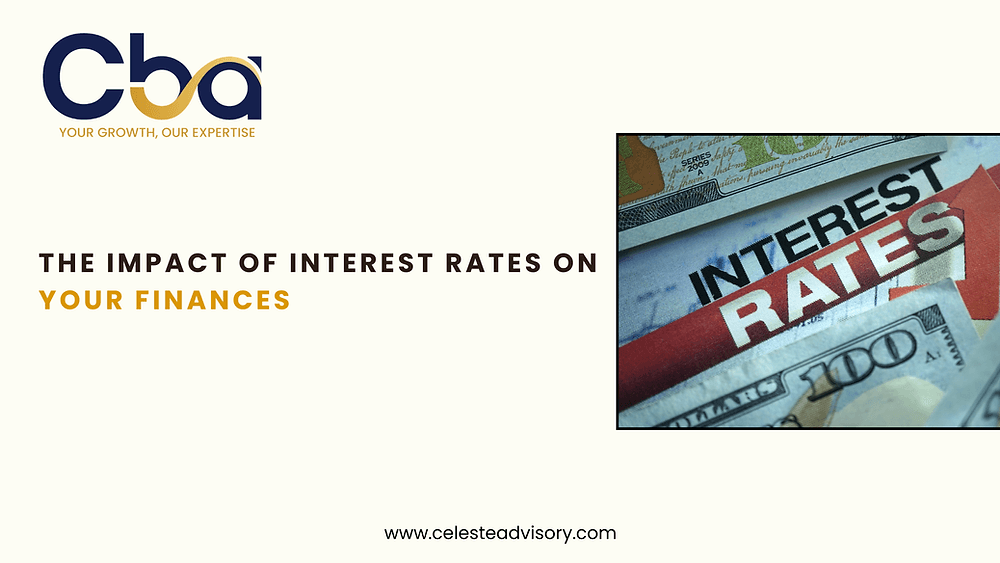
Here is the short answer. Interest rates are the price of money, and when the Federal Reserve moves them, every corner of your finances reprices: borrowing gets more or less expensive, savings yields rise or fall within weeks, bond prices move in the opposite direction of rates, and the valuations of stocks and real estate adjust to the new cost of capital. In 2026 the practical picture is a rate environment that has come down from the peaks of the tightening cycle but still sits well above the near-zero 2010s, which means debt decisions deserve more care than they used to and cash finally earns something worth collecting.
Celeste Business Advisors advises US business owners on both sides of that ledger, the debt they carry and the cash they hold. This guide walks through how rate changes reach loans, savings, and investments, and the specific moves worth making at each position.
Who Sets Rates and Why They Move
The federal funds rate is the overnight rate at which banks lend reserves to each other, and it is the lever the Federal Reserve moves to steer the economy. The Fed raises it to cool inflation by making borrowing expensive, and cuts it to stimulate activity by making borrowing cheap. Every consumer and business rate you encounter, credit cards, mortgages, credit lines, savings yields, is priced somewhere off that benchmark plus a spread for risk and profit.
The transmission is uneven by design. Credit card rates and money market yields move within weeks of a Fed decision; a 30-year fixed mortgage moves with long-term bond markets, which price where rates are expected to go rather than where they are. That gap between short and long rates is why headlines about a Fed cut do not automatically mean your mortgage quote improves.
What Rising and Falling Rates Do, Position by Position
| Where you hold it | When rates rise | When rates fall |
|---|---|---|
| Credit cards and variable loans | Payments climb within a billing cycle or two | Relief arrives, but slowly and rarely in full |
| Mortgages and term loans (fixed) | Existing loans unaffected; new borrowing costs more | Refinance windows open for loans taken at the peak |
| Savings and money market funds | Yields rise within weeks | Yields fall just as fast |
| Bonds | Prices fall; longer maturities fall hardest | Prices rise; existing bonds gain value |
| Stocks | Valuations compress, especially for growth companies | Cheaper capital supports valuations and expansion |
| Real estate | Costlier mortgages slow demand and pressure prices | Affordability improves and activity picks up |
The bond row is the one that surprises people most, so state it plainly: bond prices and interest rates move inversely because an old bond paying yesterday's lower coupon must sell at a discount to compete with new bonds paying today's higher one. The longer the bond's maturity, the bigger that price swing in both directions.
If You Are a Borrower
Variable-rate debt is where rate risk lives, so the first move in any environment is knowing exactly how much of your debt floats. High-rate flexible balances, credit cards above all, deserve payoff priority regardless of what the Fed does next; the ordering tactics are covered in our guide to paying off debt faster. For larger fixed decisions, the discipline is to borrow against your own numbers rather than a rate forecast: lenders typically want operating income of at least 1.25 times debt service, and planning at 1.5 leaves room for the years that do not go to plan.
The 2026-specific opportunity is refinancing. Debt taken at the top of the tightening cycle may now be worth re-pricing, and the best refinance conversations happen from strength, with clean financials and no missed payments, at least a year before any large maturity. The full playbook, matching loan terms to asset life and keeping every obligation on one page, is in debt management done right.
If You Are a Saver
Higher rates are the saver's dividend, but only if you collect it. Large-bank checking and savings accounts often pay near zero through entire rate cycles, while high-yield savings accounts, CDs, and money market funds pass most of the Fed's rate through within weeks. Moving idle cash from the former to the latter is the rare financial move with meaningful upside and essentially no downside; our beginner's guide to money market funds covers the standard parking spot.
The benchmark that matters is the real return: yield minus inflation. A savings yield below inflation means your balance grows while its purchasing power shrinks. When rates are falling, savers who want to hold today's yields longer can ladder CDs or Treasury bills so that maturities arrive on a schedule instead of all repricing at once.
If You Are an Investor
Rate changes hit investments through discount rates: when money costs more, future earnings are worth less today, which is why growth stocks swing harder than dividend payers in tightening cycles. The productive response is structural rather than predictive. Diversify across assets that respond differently to rates, match bond duration to when you actually need the money, and use bond ladders to turn rate uncertainty into a schedule. Chasing Fed predictions is a losing habit; the market has usually priced the consensus before you trade on it.
Real estate deserves its own line: financing costs are the dominant input, so higher-for-longer rates pressure both property prices and the math on any leveraged purchase, while falling rates do the reverse. If a purchase only works at a hoped-for future refinance rate, it does not work.
If You Run a Business
Business owners sit on both sides of every rate move at once, which is why the response has to be a system rather than a reaction. The checklist we run inside engagements: know your floating-rate exposure to the dollar; track debt service coverage monthly so a rate creep never surprises you; keep operating reserves in yield-bearing accounts instead of idle checking; and stress the forecast at rates one to two points worse than today before signing any new obligation. Pricing also belongs on the list, because your customers' borrowing costs shape their spending, and a rate cycle that squeezes them will reach your revenue with a lag.
Rates rarely move alone; they arrive tangled with inflation in costs and wages, and the combined squeeze is the real planning problem. We treat the two together in financial strategies for inflation and interest rates.
Frequently Asked Questions
What is the federal funds rate?
The federal funds rate is the overnight interest rate at which banks lend reserves to one another, set as a target range by the Federal Reserve. It is the benchmark from which most US consumer and business rates are priced, so Fed changes ripple outward into credit cards, loans, and savings yields.
Why do bond prices fall when interest rates rise?
Because an existing bond's coupon is fixed. When new bonds pay higher rates, the old bond's lower coupon is less attractive, so its price must drop until its yield matches the market. Longer-maturity bonds fall further because buyers are locked into the below-market coupon for more years.
Should I choose a fixed or variable rate loan in 2026?
Fixed rates buy certainty and are worth the premium when the payment matters to your budget or your debt service coverage is thin. Variable rates can win if rates keep declining, but that is a forecast, not a plan. A useful test: if a two-point rate rise would strain the payment, take the fixed rate.
How fast do Fed rate changes reach my accounts?
Credit card rates and money market yields typically adjust within weeks of a Fed move. Home equity lines and variable business loans reset with their next cycle. Fixed mortgage rates follow long-term bond markets instead, so they often move before or after the Fed rather than with it.
Where should savings sit when rates are falling?
Keep true emergency money liquid in a high-yield account or money market fund and accept the drifting yield; its job is availability. For cash beyond that with a known timeline, CD or Treasury ladders lock today's rates for part of the balance while keeping maturities arriving on a regular schedule.
The Bottom Line
Interest rates decide what your debt costs, what your cash earns, and what your assets are worth, and you control none of that. What you do control is your exposure: how much of your debt floats, whether your cash collects the yield on offer, whether your bond risk matches your timeline, and whether your business plan survives rates staying higher than you hoped. Set those positions deliberately and the Fed's next meeting becomes news rather than a threat.
If you want a clear read on how your debt, cash, and forecast hold up in this rate environment, our fractional CFO service builds that review into a monthly rhythm. Talk to us to get started.