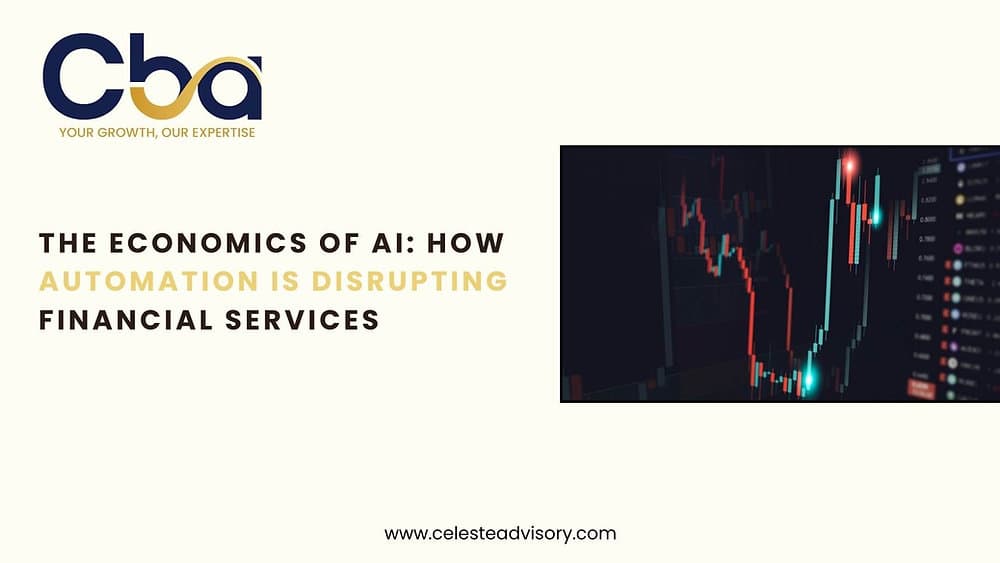
The economics of AI in financial services reduce to one sentence: AI collapses the marginal cost of analysis toward zero, so any task that is mostly pattern recognition on data, fraud screening, credit underwriting, portfolio rebalancing, expense categorization, becomes cheaper, faster, and available far further down-market than it used to be. That is why robo-advisors manage portfolios for a fraction of traditional advisory fees, why banks screen millions of transactions in real time, and why a small business finance team in 2026 can run reporting that once required an analyst headcount. The disruption is real. So are the limits, and both matter to anyone running a business on the receiving end of it.
Celeste Business Advisors works at the practical end of this shift, using AI-capable accounting platforms inside bookkeeping and CFO engagements for US small and mid-sized businesses. This article covers where the economics have actually moved: investing, banking, and the finance function itself.
The Core Economics: Cheap Analysis Changes Who Gets Served
The economics of AI describe what happens when the cost of producing an analysis, a credit decision, a fraud check, a portfolio adjustment, falls from hours of skilled labor to fractions of a cent of compute. Two consequences follow. First, incumbents automate their highest-volume decisions and take out cost. Second, and more disruptive, services that were only economical for wealthy clients or large accounts become viable for everyone: automated advisory for small portfolios, credit models for thin-file borrowers, real-time financial reporting for businesses that could never afford an analyst. Most of what looks like AI disruption in finance is this second effect, distribution widening as unit costs fall.
AI in Investing: From Aladdin to Robo-Advisors
Institutional investing adopted the tools first. BlackRock's Aladdin platform applies large-scale analytics to portfolio risk across trillions of dollars in assets, and quantitative funds have used machine learning to hunt patterns in prices, filings, and market sentiment for years. Sentiment analysis, mining news flow and public commentary for early signals about companies and sectors, is now a standard input rather than an edge.
The consumer-facing version is the robo-advisor. A robo-advisor is an automated platform that builds and rebalances a diversified portfolio from an investor's goals and risk tolerance, for fees well below traditional advisory rates. Betterment and Wealthfront made the model mainstream, and the deeper story is the economics: portfolio construction that once justified a one percent annual fee on large accounts became software that serves small accounts profitably. The technology behind this shift, and where machine learning models actually add value, is ground we cover in AI and machine learning in financial services.
AI in Banking: Fraud, Service, and Underwriting
Banking shows the clearest before-and-after. Fraud detection once meant rules engines and after-the-fact review; AI systems now score transaction patterns in real time, and institutions like JPMorgan Chase screen enormous daily volumes this way, catching anomalies no manual process could reach. Customer service moved from call centers to assistants like Bank of America's Erica, which handles routine account questions, payments, and alerts at near-zero marginal cost per interaction.
Underwriting is the most economically interesting case. Traditional credit decisions lean on credit scores and standardized ratios. AI-based lenders such as Upstart underwrite from a much wider set of variables, which can extend credit to borrowers a traditional model would reject on file thinness alone. The same mechanics apply to bank risk management, where models digest macroeconomic and market data to flag exposure earlier. The gains are real, and so is the caveat covered below: a model trained on biased history can automate that bias at scale.
What Automation Changes, Function by Function
| Function | Before automation | What AI changes |
|---|---|---|
| Fraud detection | Rules engines, manual review queues, after-the-fact catches | Real-time transaction scoring across the full payment stream |
| Credit underwriting | Credit score plus standardized ratios; thin files rejected | Broader variable sets; faster decisions; wider (but bias-sensitive) access |
| Portfolio management | Human advisors, economical only above high account minimums | Automated construction and rebalancing at low fees for small accounts |
| Customer service | Call centers with per-interaction labor cost | AI assistants handling routine service at near-zero marginal cost |
| Bookkeeping and reporting | Manual categorization, month-end lag, analyst-built reports | Automated categorization and drafting inside QuickBooks and Xero; near-real-time visibility |
The Finance Function: Where SMBs Feel It Directly
For business owners, the most consequential row in that table is the last one. Personal finance felt the shift first, with apps that categorize spending automatically and services like Credit Karma applying models to credit monitoring. By 2026 the same economics have reached the SMB back office: QuickBooks and Xero both ship AI assistants that categorize transactions, reconcile accounts, chase receipts, and draft variance commentary, and large language models handle the summarization and first-draft analysis that used to consume junior staff hours.
What this changes is the price of visibility. A business that once saw its numbers six weeks after month-end, if at all, can now run near-real-time dashboards on tooling that costs less per month than one bookkeeper hour. What it does not change is judgment: the software categorizes, but someone still has to decide what the margin trend means and what to do about it. Our rundown of AI tools for finance teams covers the practical stack, and our own model is the human-plus-machine version: automation does the processing, experienced CFOs and accountants do the deciding.
The Costs and Risks on the Other Side of the Ledger
Honest economics count both columns. Data privacy is the first liability: AI systems concentrate sensitive financial data, which concentrates the payoff for attackers, and a business adopting these tools inherits the exposure, a topic we treat fully in our piece on cybersecurity in financial transactions. Algorithmic bias is the second: models trained on historical lending data can reproduce historical discrimination with a veneer of objectivity, which is why regulators scrutinize AI underwriting and why "the model decided" is not a defense. Job displacement is the third and most human: routine processing roles, data entry, basic reconciliation, first-pass document review, are shrinking, while the premium shifts to people who can supervise the tools and exercise the judgment they lack. And generative AI adds a newer risk with a plain name: models state wrong numbers fluently, so any AI output feeding a financial decision needs verification against source data. Speed without verification is just faster error.
What a Business Owner Should Actually Do
Three moves capture most of the value with little of the risk. Adopt the automation inside tools you already trust, letting your accounting platform's AI handle categorization and reconciliation before shopping for anything exotic. Keep a human review layer on every number that drives a decision, whether that layer is you, your accountant, or a fractional CFO. And bank the savings deliberately: the hours automation frees are only worth something if they move into higher-value work, collections, pricing, forecasting, rather than dissolving into the week. Owners who want help sequencing this can lean on a fractional CFO to pick the tools and build the review rhythm around them.
Frequently Asked Questions
Will AI replace accountants and CFOs?
AI is replacing tasks, not roles: categorization, reconciliation, first-draft reports, and routine screening are automating quickly. Judgment work, interpreting results, structuring finances, managing lenders and taxes, and making decisions under uncertainty, remains human, and the professionals who pair those skills with AI tooling are becoming more productive rather than obsolete.
How does AI reduce costs in financial services?
By collapsing the marginal cost of analysis: a fraud check, credit decision, or portfolio rebalance that once required skilled labor becomes software running at fractions of a cent. Institutions save on volume, and services once reserved for large accounts, such as automated investment management, become economical for small ones.
Is AI-based lending fair?
It can widen access, since models that read more than a credit score can approve creditworthy borrowers with thin files. But models trained on biased historical data can also automate discrimination, which is why US regulators require lenders to explain adverse decisions and test models for disparate impact. Fairness depends on the training data and the oversight, not the technology itself.
What AI should a small business use in its finances first?
Start inside your accounting platform: the AI features in QuickBooks and Xero automate transaction categorization, reconciliation, and receipt capture with minimal setup and immediate time savings. Add reporting or forecasting tools once the books are clean, and keep a human review on any output that feeds a real decision.
Is financial data safe with AI tools?
Established platforms invest heavily in security, but AI tools concentrate sensitive data and therefore concentrate risk. Practical safeguards: use vendors with clear data-handling policies, never paste sensitive financials into consumer chatbots that train on inputs, enable multi-factor authentication, and limit tool access to the people who need it.
The Bottom Line
AI is disrupting financial services the way automation always disrupts an industry: by making the expensive thing cheap and forcing everyone to compete on what still requires judgment. Investing, banking, and the back office have all crossed the line where the processing is commodity and the thinking is the product. For business owners the opportunity is concrete: analyst-grade visibility into your own numbers at small-business prices, provided someone competent is reading them.
If you want the automation without the blind spots, our strategic bookkeeping and CFO services run AI-capable tooling with experienced humans on top. Talk to us about what the 2026 stack can take off your plate.