Here is the short answer. Fractional CFO services transform a business by putting senior financial judgment behind every major decision without the cost of a full-time executive. In practice that means four changes: cash stops being a surprise because someone owns a rolling forecast, big commitments get priced before they are made, your financials become clean enough that banks and investors move faster, and the finance function finally has an owner who is accountable for it. The engagement typically costs a few thousand dollars a month, against a full-time CFO salary that runs well into six figures before benefits.
Celeste Business Advisors provides fractional CFO services to US businesses between $1M and $20M in revenue. This article explains what the role actually covers, where the transformation shows up first, and how to tell whether your business is ready for one.
What Is a Fractional CFO?
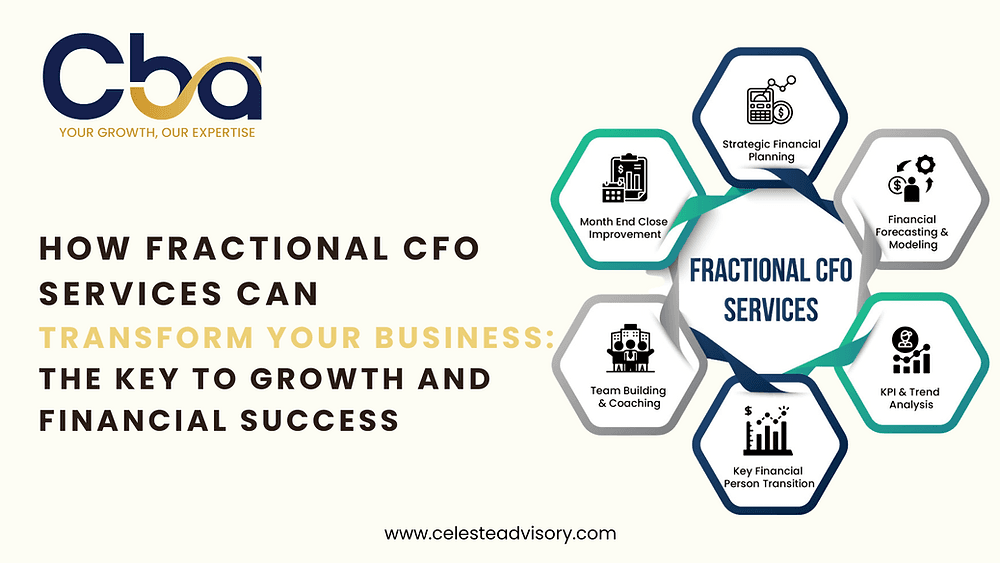
A fractional CFO is a senior finance executive who works with your company part-time, usually on a monthly retainer, doing the strategic work a full-time CFO would do: forecasting, budgeting, pricing, capital planning, lender relationships, and investor-grade reporting. The model exists because most businesses under roughly $30M in revenue need CFO-level thinking a few days a month, not forty hours a week. You get the judgment without the payroll load, and the engagement scales up or down as the business changes. It is a different job from a bookkeeper, who records transactions, and a controller, who runs the accounting process; the table below shows where the lines fall.
Who Does What: Bookkeeper vs Controller vs CFO
| Role | What they own | Typical cost model | When you need it |
|---|---|---|---|
| Bookkeeper | Recording transactions, reconciliations, clean monthly books | Hourly or flat monthly fee | From day one |
| Controller | Accounting process, close discipline, compliance | Salaried or fractional | As volume and complexity grow |
| Fractional CFO | Forecasting, strategy, pricing, capital, lender and investor readiness | Monthly retainer, part-time | Roughly $1M-$20M revenue, decisions getting bigger |
| Full-time CFO | All of the above plus daily executive leadership | Six-figure salary plus benefits and often equity | Usually $30M+ revenue or heavy transaction activity |
Where the Transformation Actually Shows Up
Cash flow becomes managed, not observed
The first deliverable in most engagements is a 13-week cash forecast, updated weekly, that shows exactly when money arrives and leaves. From there the work turns operational: tightening collections so customers pay on time, negotiating supplier terms, and shortening the gap between paying for work and getting paid for it. Businesses that were permanently anxious about payroll discover the anxiety was a visibility problem, not always a cash problem. Where a real shortfall exists, the forecast surfaces it months early, while there are still good options.
Decisions get priced before they are made
A new hire, a second location, a piece of equipment, a price change: each of these is a financial model before it is a commitment. A fractional CFO builds the model, shows the downside case alongside the base case, and gives you a number for what the decision costs if it goes to plan and what it costs if it does not. Owners describe this as the single biggest change in how the business feels to run, because arguments about direction become comparisons between scenarios.
Reporting turns into decisions
A fractional CFO replaces the shoebox of statements you get at year-end with a monthly reporting package: profit and loss, balance sheet, cash position, and a short list of KPIs against plan, delivered days after close with a plain-English note on what changed, why, and what to do about it. Gross margin drifting down two points, a service line quietly losing money, a customer stretching payments: these show up in month one of the trend, not at year-end when the damage is done.
Capital gets cheaper and easier to raise
Banks lend faster and on better terms to businesses whose numbers explain themselves, and investors behave the same way. A fractional CFO packages financials the way credit committees and diligence teams want to read them, builds the forecast that supports the ask, and runs the comparison across term sheets so you negotiate rather than accept. If a loan, a line of credit, or outside investment is anywhere on your two-year horizon, this alone can repay the engagement.
Risk and compliance get an owner
Someone is now paid to ask the uncomfortable questions: what happens if the biggest customer leaves, whether internal controls would catch a fraudulent payment, whether the business is exposed on sales tax across states, whether insurance matches reality. Most owners know these questions exist; the transformation is having a named person responsible for answering them before they become expensive.
What the First 90 Days Look Like
A typical engagement starts with a diagnostic: the CFO reads the last year of financials, interviews the owner, and reviews how the books are kept. Weeks two through six usually pair clean-up with construction, fixing the chart of accounts and close process while building the 13-week cash forecast and the annual model. By month three the rhythm is running: a monthly reporting package, a standing finance meeting, and a live forecast that decisions get tested against. From there the work follows the business, whether that is a financing round, a pricing overhaul, margin work, or preparing for an eventual sale. The compounding effect over a year is what our article on scaling without the growing pains walks through in detail.
Is Your Business Ready for One?
The signals are consistent: revenue past roughly $1M, decisions on the table with real dollar consequences, cash that surprises you more than once a year, financials you see quarterly or annually instead of monthly, or a loan or investment conversation coming. If several of those apply, the cost of going without is usually larger than the fee, a case we lay out in the hidden costs of not hiring a fractional CFO. One honest counter-signal: if the books themselves are unreliable, start with a good bookkeeper first, because a CFO forecasting from bad data is expensive guesswork. And if you are weighing part-time against a full-time hire, our comparison of a virtual CFO versus a full-time CFO covers the cost math and the fit.
Frequently Asked Questions
What does a fractional CFO cost?
Most engagements for businesses between $1M and $20M in revenue run a few thousand dollars a month, scaled to scope and meeting cadence. A full-time CFO carries a six-figure salary plus benefits and often equity. The fractional model delivers the strategic layer of that role for a fraction of the cost, which is the point.
What is the difference between a fractional CFO and a virtual CFO?
In practice the terms are close to interchangeable. Fractional emphasizes the part-time engagement model; virtual emphasizes that the work happens remotely over cloud accounting tools. Both describe a senior finance executive serving your business on a recurring, less-than-full-time basis. Scope and seniority matter far more than the label.
Do I still need a bookkeeper if I hire a fractional CFO?
Yes. Bookkeeping and CFO work are different layers of the same stack. The bookkeeper produces accurate, timely records; the CFO turns those records into forecasts, pricing, and capital decisions. A CFO working from messy books spends your retainer on clean-up, so many businesses pair the two services deliberately.
How many hours a month does a fractional CFO work?
Typical engagements run from a few hours to a few days per month, anchored by a monthly close review and finance meeting, with the forecast maintained in between. Intensity flexes around events: a financing round, a budget season, or an acquisition can temporarily double the involvement, then it settles back.
How quickly should I expect results?
Visibility arrives fast: most businesses have a working cash forecast and their first real reporting package inside 60 to 90 days. Financial outcomes such as better margins, cheaper borrowing, and stronger cash position compound over quarters, because they come from a sequence of better-priced decisions rather than a single fix.
The Bottom Line
The transformation a fractional CFO brings is not a document or a dashboard. It is that every significant decision in the business starts getting made with a forecast, a downside case, and a senior second opinion, at a cost a growing company can actually carry. The businesses that feel different a year in are the ones where the owner stopped being the only person thinking about the numbers.
If that is the change you want, our fractional CFO service is built for businesses between $1M and $20M in revenue. Talk to us and we will start with an honest read on where your finances stand.