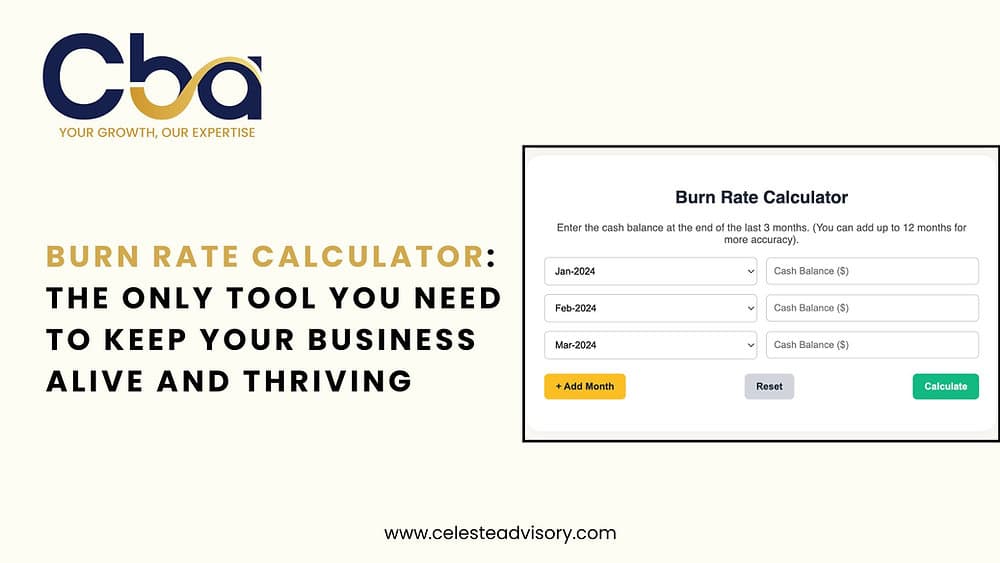
Here is the short answer. Burn rate is the speed at which your business spends its cash, runway is how many months you can operate at that pace before the cash is gone, and both come from numbers you already have. If you hold $50,000 in the bank and lose $10,000 a month, your runway is five months. That single calculation, refreshed monthly, tells you when to cut costs, when to push revenue, and when to arrange financing while you still have leverage.
You do not need to be a math genius to run this. You need one formula, honest inputs, and a monthly habit. Celeste Business Advisors tracks burn and runway inside our CFO engagements for US businesses between $1M and $20M in revenue, and the method below is the one we actually use.
What Burn Rate Is and Why It Sets Your Timeline
Burn rate is the rate at which a business spends its available cash, usually measured per month. Picture a bucket of water, your cash reserve, with small holes in the bottom: payroll, rent, software subscriptions, marketing. The speed of the leak is your burn rate.
Two versions matter, and they answer different questions:
- Gross burn rate is your total monthly operating spend, regardless of what you earn. It measures the size of your cost base.
- Net burn rate is monthly spend minus monthly revenue, the amount your cash balance actually drops each month. This is the number that determines survival.
A business spending $50,000 a month while collecting $30,000 has a gross burn of $50,000 and a net burn of $20,000. Lenders and acquirers look at both; your runway depends on net.
Runway: The Deadline Hiding in Your Bank Balance
Runway is the number of months a business can keep operating before its cash runs out, assuming the current net burn rate holds.
Runway = Current Cash ÷ Monthly Net Burn
With $50,000 in the bank and a $10,000 monthly net burn, you have five months. That is not a reason to panic; it is a deadline for one of three moves: cut costs, grow revenue, or bring in outside cash. The owners who get into real trouble are rarely the ones with short runways. They are the ones who never measured.
How to Calculate Burn Rate Step by Step
Step 1: Pull your recent cash balances
Take the ending cash balance from your last three months of bank statements:
- March: $70,000
- April: $60,000
- May: $50,000
Step 2: Apply the formula
Burn Rate = (Starting Cash - Ending Cash) ÷ (Number of Months - 1)
Why subtract one? Because you are measuring intervals, not data points. Three month-end balances cover two full months of burn: March to April, and April to May. So the math is ($70,000 - $50,000) ÷ 2, which gives a net burn of $10,000 per month.
Step 3: Convert it to runway
Divide current cash by that burn: $50,000 ÷ $10,000 = five months. Recalculate every month, because both the cash balance and the burn itself keep moving.
Three Businesses, Three Very Different Runways
The same formula reads very differently depending on the business behind it. Here are three common profiles:
| Business | Monthly revenue | Monthly expenses | Net burn | Cash in bank | Runway |
|---|---|---|---|---|---|
| SaaS company scaling fast | $30,000 | $50,000 | $20,000 | $100,000 | 5 months |
| Direct-to-consumer brand | $10,000 | $12,000 | $2,000 | $20,000 | 10 months |
| Bootstrapped agency | $15,000 | $14,000 | -$1,000 (profit) | Growing | Self-funding |
The SaaS company is spending aggressively ahead of revenue; if income does not climb within five months, it needs financing or a serious cost reset. The consumer brand has a longer cushion, but the right use of those ten months is building toward profitability, not just spending the time. The agency adds cash every month, which means no urgency, no forced decisions, and full control of its own pace. Profitability, even in small doses, buys freedom.
Where Burn Rate Calculations Go Wrong
- Using gross instead of net. Gross burn shows the cost base, but net burn, your actual loss after income, is what determines runway. Plan against the wrong one and you are flying blind.
- Ignoring lumpy expenses. Annual software renewals, insurance premiums, year-end bonuses, and quarterly estimated tax payments do not appear in a typical month. Spread them across the year or your runway is overstated.
- Calculating it once. Burn moves with hiring, pricing, and seasonality. A number from last quarter is a historical curiosity, not a control. Review it monthly, ideally as part of a broader financial health check.
- Treating runway as permission to coast. Six months of runway means six months to fix the underlying economics, not six months before you need to start thinking about them.
How to Reduce Burn Without Stalling Growth
Cutting burn does not mean slamming the brakes. It means spending with intention:
- Put every dollar in a bucket. Team, tools, marketing, operations. Visibility comes before any intelligent cut, and modern accounting software makes the categorization nearly automatic.
- Renegotiate fixed costs. Office space, software seats, vendor contracts. There is usually room to save without touching quality, especially on subscriptions nobody has reviewed in a year.
- Stage your hiring. Contractors and part-time specialists can bridge a gap that a full-time salary would turn into permanent burn.
- Cut marketing that does not convert. Measure return by channel, stop what is not working, and reinvest in what is.
- Make revenue more predictable. Retention, renewals, and upsells stabilize the income side of net burn, which lengthens runway without cutting anything. The wider playbook is in our guide to mastering cash flow.
One more distinction keeps owners honest: planned burn is not a problem. If you are spending ahead of revenue on product, people, or capacity, with a forecast that shows when it pays back, that is investment. Unplanned burn, spending on autopilot with no payback date, is the kind that kills. The discipline that separates them is the same one that separates profit from cash flow, and it shows up in the numbers long before it shows up anywhere else.
Frequently Asked Questions
What is the difference between gross burn rate and net burn rate?
Gross burn rate is total monthly operating spend before any income is counted. Net burn rate subtracts monthly revenue, showing how much the cash balance actually falls each month. Runway is always calculated on net burn, while gross burn is the better measure of how large the cost base has grown.
How much cash runway should a small business keep?
Most advisors suggest holding at least three to six months of operating expenses in reserve, and more if revenue is seasonal or concentrated in a few customers. A business deliberately spending ahead of revenue should hold enough runway to cover the plan plus a buffer, because plans usually take longer than forecast.
How often should I recalculate my burn rate?
Monthly, at the same time you review your financial statements. Expenses shift, revenue moves, and one large annual payment can change the picture materially. A monthly recalculation catches the drift while there is still time to respond.
Is a negative net burn rate good?
Yes. A negative net burn means revenue exceeds expenses, so the business adds cash every month instead of consuming it. In runway terms it is effectively unlimited, which removes the pressure to raise money or make forced cuts.
Can a profitable business still run out of cash?
It can. Profit is recognized when revenue is earned, while cash arrives only when customers actually pay, so a business with slow-paying customers can post profits on paper and still miss payroll. That is why burn and runway are tracked on bank balances, not on the income statement.
The Bottom Line
Burn rate is your business timeline expressed as a single number. Calculate it from real bank balances, track it monthly, separate planned burn from drift, and treat runway as the deadline it is. Owners who do this make cost, hiring, and financing decisions from a position of clarity; owners who skip it find out about problems when the bank balance announces them.
If you want that clarity without building it yourself, our fractional CFO service puts burn tracking, forecasting, and scenario planning into a monthly rhythm, run by a team that includes seasoned CPAs and CMAs. Talk to us and we will map your runway together.