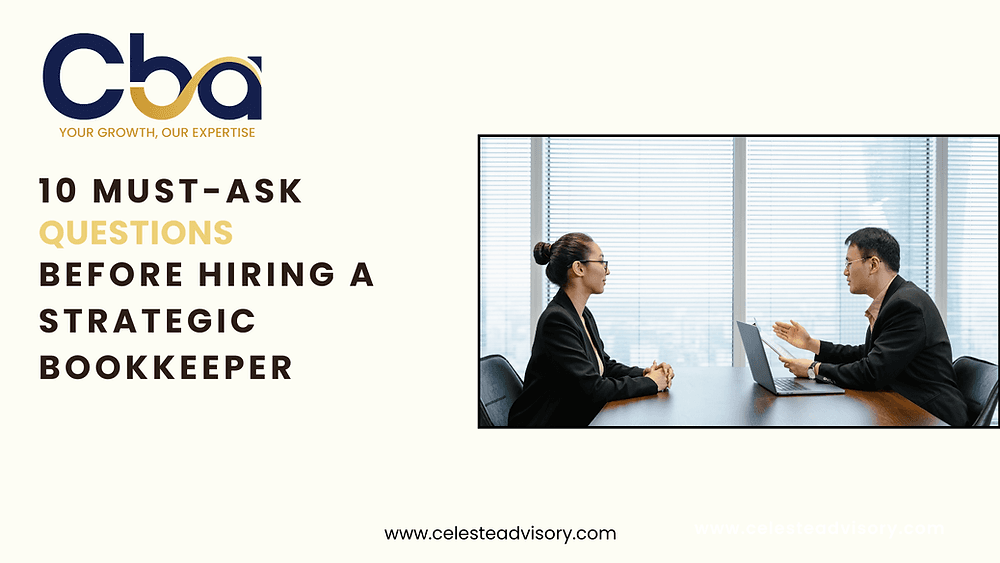
Here is the short answer. Before hiring a strategic bookkeeper, ask about ten things: industry experience, software fluency, accuracy process, the reports you will receive, communication habits, tax-season preparation, data security, ability to scale with you, fee structure, and why they believe they fit your business. The thread running through all ten is the same: you are not buying data entry, you are buying financial clarity, and the interview should test for clarity at every step.
A strategic bookkeeper is a bookkeeper who goes beyond recording transactions to deliver the reporting, process discipline, and insight that support better business decisions. The right one quietly upgrades your whole financial operation; the wrong one leaves you with mismanaged books, missed opportunities, and cleanup costs. These ten questions, drawn from the bookkeeping engagements Celeste Business Advisors runs for US small and mid-sized businesses, are how you tell the difference before you sign.
Transactional vs Strategic Bookkeeping
| Dimension | Transactional bookkeeper | Strategic bookkeeper |
|---|---|---|
| Scope | Records transactions, reconciles accounts | Also interprets the numbers and flags what they mean |
| Reporting | Standard statements on request | Monthly P&L, cash flow, balance sheet, and KPIs on a schedule |
| Cadence | Reactive; surfaces at tax time | Proactive; regular check-ins and early warnings |
| Tax season | Hands over raw records | Delivers CPA-ready books and coordinates directly with your tax advisor |
| Growth | Same service regardless of size | Adds budgeting, forecasting, and analysis as you scale |
Every question below is really a probe for which column your candidate lives in.
Questions 1-3: Fit, Tools, and Accuracy
1. What experience do you have in my industry?
Industry context changes what good bookkeeping looks like. E-commerce businesses need inventory accounting, multi-channel revenue tracking, and fluency with platform fees from Amazon or Shopify. Service businesses need project costing, profitability tracking, and time-based invoicing so revenue is captured accurately. Real estate companies need property-level records and the compliance details that come with them. An industry-experienced bookkeeper starts useful on day one and spots the cost-saving patterns a generalist overlooks. Ask for examples of clients in your industry and the specific problems they solved.
2. Are you fluent in my accounting software?
Whether you run QuickBooks, Xero, NetSuite, or FreshBooks, your bookkeeper should be proficient in it before they touch your books; training them on your time is a hidden cost you did not agree to. If you have no system yet, flip the question into a test: a strategic bookkeeper should be able to recommend a setup that fits your size and goals and explain why. In 2026 that includes knowing the AI-assisted features these platforms now ship, like automated categorization and anomaly flagging, and knowing their limits.
3. How do you ensure accuracy?
Accuracy is the foundation of everything else, and a serious candidate will describe a process, not a personality trait: scheduled reconciliations against bank statements, consistent transaction categorization, documented review steps, and tools that flag inconsistencies automatically. Small errors compound into compliance problems and bad decisions, which is why sloppy process shows up later as the classic cleanup projects we describe in the seven bookkeeping mistakes small business owners make. A vague answer here is disqualifying.
Questions 4-6: Reporting, Communication, and Tax Season
4. What reports will you provide, and how often?
A financial report is only useful if it arrives on a schedule and you can act on it. The baseline set is a profit and loss statement showing revenue and expenses, a cash flow report tracking money in and out, and a balance sheet snapshotting assets, liabilities, and equity. A strategic bookkeeper will also build KPI dashboards around the metrics that matter for your model, and will customize reports for your goals or your lenders. If reporting only happens when you ask, you are looking at the transactional column of the table above.
5. How do you communicate?
Ask about frequency, channel, and response time: will updates come weekly or monthly, over email, Zoom, or Slack, and how fast do urgent questions get answered. Financial issues age badly, so slow responses are expensive. The underrated test is translation: have them explain something from your own books in plain language. A bookkeeper who can turn numbers into sentences you act on is the partner you want; one who hides behind jargon keeps you dependent instead of informed.
6. How do you prepare for tax season?
Bookkeepers are not tax professionals, but they determine whether tax season is calm or chaotic. The right answer covers three things: clean, complete, well-organized records at year-end; direct coordination with your CPA or tax advisor rather than passing files through you; and a defined year-end close process so nothing is being reconstructed in the weeks before IRS deadlines. Disorganized books are how businesses end up filing late or overpaying, so ask specifically how they have handled year-end for businesses like yours.
Questions 7-8: Security and Scale
7. What security measures protect my data?
Your financial records are among your most sensitive business assets. Ask where data is stored, whether it is encrypted, who on their team can access it, and how access is revoked when someone leaves. Reputable cloud accounting platforms provide strong foundations, but the bookkeeper's own practices, password discipline, permission scoping, secure document exchange, matter just as much. A candidate who downplays security is telling you how they will treat everything else you cannot see.
8. Can you scale with my business?
Bookkeeping needs grow more complex as revenue grows: more transactions, more accounts, payroll, inventory, sometimes multiple entities. Ask whether they have supported businesses through meaningful growth and what changed in the engagement as it happened. The best answer includes services you do not need yet, budgeting, forecasting, financial analysis, because that headroom is what makes the relationship durable. Choosing between building this capacity in-house or buying it is its own decision, which we compare in outsourced bookkeeping versus in-house accounting.
Questions 9-10: Fees and Fit
9. What is your fee structure?
Get the pricing model in writing before you commit: hourly, flat monthly fee, or retainer, and exactly which services each covers. Ask what triggers extra charges, whether software subscriptions are included, and request a sample invoice so the structure is concrete. Transparent pricing is not just budgeting hygiene; how a bookkeeper handles the money conversation with you predicts how carefully they will handle money for you.
10. Why should I hire you?
The open-ended closer earns its place. Strong candidates connect their experience to your situation, share problems they have solved that resemble yours, and show genuine interest in your business rather than reciting credentials. Listen for the balance of confidence and honesty, including what they would not take on. You are choosing a long-term financial partner, and this answer shows you who they are when there is no script.
Before You Sign: Two Final Checks
References first: speak to two or three current or former clients, ideally in your industry, and ask what the bookkeeper catches, how they communicate, and what they wish they had known at signing. Then run a bounded trial, one month or one defined project, before committing long-term. A trial reveals responsiveness, accuracy, and fit faster than any interview. The payoff for choosing well is compounding: cleaner cash flow management, records you never second-guess, hours back every week, and the kind of insight that turns bookkeeping into a growth tool, a connection we detail in five ways smarter bookkeeping improves cash flow.
Frequently Asked Questions
What is the difference between a bookkeeper and a strategic bookkeeper?
A bookkeeper records transactions and keeps accounts reconciled. A strategic bookkeeper does that and then uses the records to inform decisions: scheduled reporting, KPI tracking, early warnings on cash flow, and coordination with your CPA. The difference shows up in cadence and interpretation, not just task lists.
How much does a strategic bookkeeper cost?
Pricing depends on transaction volume, complexity, and scope, and is typically structured as hourly billing, a flat monthly fee, or a retainer. Rather than anchoring on a number, ask each candidate for a written breakdown of what their fee includes and what costs extra. The right comparison is against the cost of errors, missed deadlines, and your own hours spent on books.
Should my bookkeeper also do my taxes?
Usually not; bookkeeping and tax preparation are different disciplines, and most businesses pair a bookkeeper with a CPA or tax advisor. What your bookkeeper must do is make tax season easy: clean year-end records, organized documentation, and direct collaboration with your tax professional. That coordination is where a strategic bookkeeper earns their fee in the fourth quarter.
What software should my bookkeeper know?
They should be proficient in whatever your business runs, commonly QuickBooks or Xero for small businesses, with NetSuite and FreshBooks appearing as businesses specialize or scale. Fluency includes the automation and AI-assisted features these platforms now include, plus the integrations your business depends on, like payroll, inventory, or e-commerce connections.
When should a business move from DIY bookkeeping to hiring one?
When the books stop being current, when month-end takes owner hours that should go to customers, or when you are making decisions without reliable numbers. Growth events like hiring employees, adding inventory, or seeking financing all raise the stakes on accurate records. Most owners hire later than they should; the cleanup cost usually exceeds what timely help would have cost.
The Bottom Line
Hiring a strategic bookkeeper is a partnership decision disguised as a procurement decision. The ten questions, industry fit, software fluency, accuracy process, reporting, communication, tax readiness, security, scalability, fees, and fit, exist to surface how a candidate thinks, not just what they charge. Ask them all, check references, and run a trial before you commit.
If you want a team that answers all ten well on the first pass, our strategic bookkeeping service pairs clean monthly books with the reporting and insight this whole article is about. Talk to Celeste Business Advisors and put the questions to us directly.